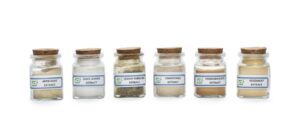
In the SustaiNext project, we looked at the biorefinery that is turning plant feedstocks into botanical extracts of varying concentrations. This advanced industrial facility is a part of a value chain, which also involves the regional production of various types of feedstocks.
From a Life Cycle Assessment (LCA) perspective, this is a multi-output system, for which we built a cradle-to-gate model using a mix of primary data from project partners and secondary data from an environmental database. For the first valorization route studied, that relies on olive leaves as feedstock, the output are several polyphenol extracts (P.E.) at various concentrations (20%, 25%, and 40%), as seen in the graph.
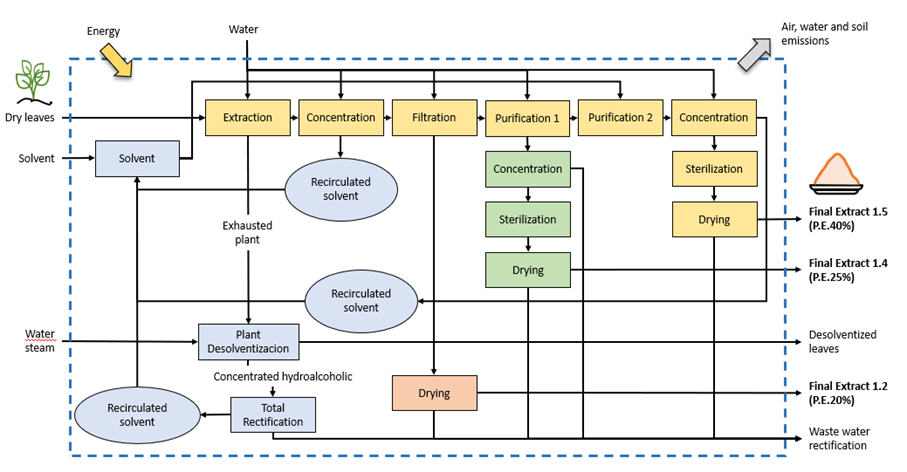
We had to consider how to allocate the environmental impacts correctly for these products. System expansion wasn´t really feasible, so we compared allocation by mass, by market value, and by polyphenol content. The economic and content-based allocations turned out to reflect the system’s reality better than just going by mass allocation.
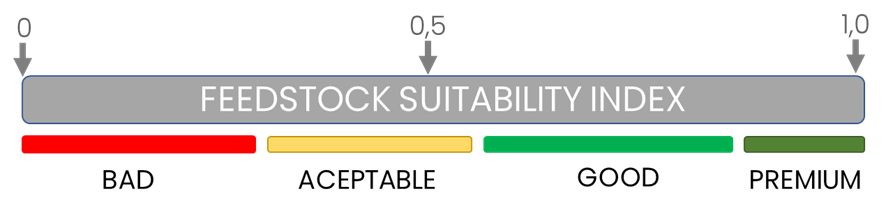
To go a step further, we also included a feedstock suitability index (FSI) in this LCA. FSI is a numerical quantifier expressing the overall suitability of a given feedstock for a specific valorisation route. FSI added context to the LCA, as it is a benchmark for the upstream choices, because e.g., a low FSI in the feedstock leads to a lower process output.
The results showed that higher concentration extracts have higher environmental burdens due to extra processing. In this paper we also show that, in multi-output systems, it is important to understand both well, the way to handle co-products and the variability of feedstocks (FSI) – Transparency in those choices is key.
The work continues for the coming 2,5 years, and we plan to further use our LCA methodology and models to assess the many different valorization routes and feedstocks in SustaiNext, to support decision-making in real-world supply chains.
Here is the full LCA paper to read more details: https://publications.waset.org/10014235.pdf
Dr. Adriana Díaz Triana, ECODESIGN company GmbH (WP5 leader)
Photo credit: © Foto Studio Weinwurm, , all rights reserved.