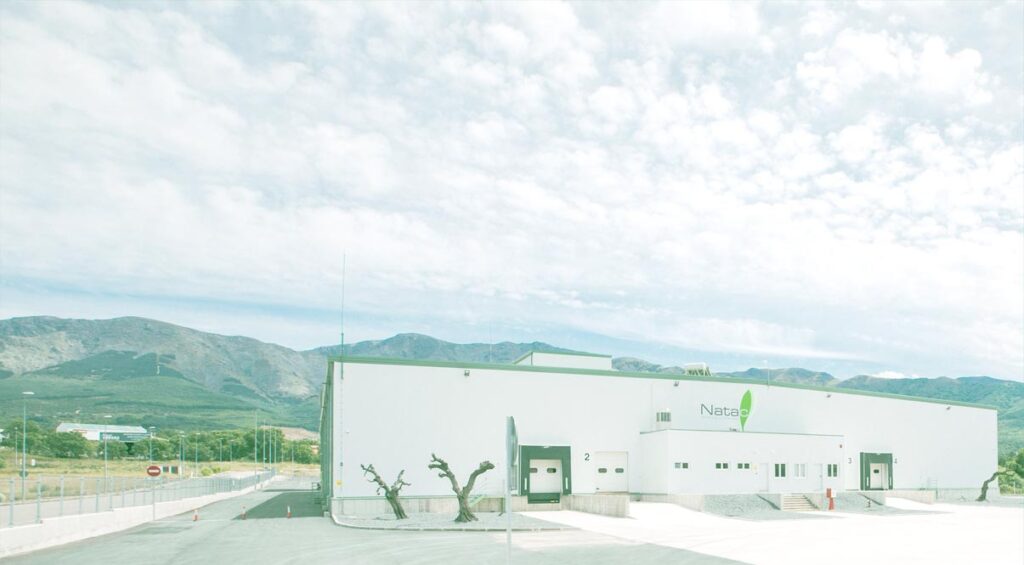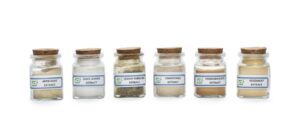
Within the SustaiNext project, Natac leads Work Package 3 DYANA BIOREFINERY: Achieving maximum value & zero waste,which represents the core of the production plant and acts as the link between the six feedstock inputs and the generation of 46 plant-based healthy extracts and functional ingredients. This central role is closely connected to the work carried out by Emilija Ivanova, Senior Scientific Researcher at Natac, who is actively involved in the technical development of WP3 activities.
Emilija Ivanova holds a Ph.D. in Biosciences, with academic training in Biochemistry, Physiology and Microbiology. Throughout her career, she has worked in research and development and quality control roles, both in academic institutions and in industry. For the past eight years, she has been part of Natac’s R&D team, contributing to multiple projects focused on the chemical characterisation, isolation and purification of bioactive compounds from plant matrices, as well as on the evaluation of their biological activities. She currently works as a Senior Scientific Researcher within Natac’s Scientific Department, where she is responsible for the monitoring and execution of the technical tasks of the projects in which the company participates, particularly those involving the investigation of biological activities. In parallel, she provides product-related scientific content to the commercial and marketing teams that supports the efficacy of Natac’s products and is consistent with the company’s overall strategy.
“Within SustaiNext, WP3 represents the core of the production plant, acting as the link between the six feedstock inputs and the generation of 46 plant-based healthy extracts and functional ingredients”, she says.
This work package is built around SustaiNext’s “first-of-its-kind multi-circular and sustainable biorefinery”, integrating 12 distinct production workflows, or valorisation routes, that define the sequence of operations required to manufacture all defined bioproducts from olive, artichoke, cardoon, pomegranate, rosemary, lemon verbena and chamomile feedstocks. These routes combine innovative technologies and carefully engineered process designs to ensure the full valorisation of the available biomass.

“Over the last two years, work has focused on scaling up the production processes defined in the 12 valorisation routes to enable efficient industrial-scale implementation. This entails a tailored optimisation of each step of the production process and its adaptation to the new and existing industrial equipment in the flagship biorefinery. We’ve also placed strong emphasis on reducing energy and solvent consumption to reach zero waste. So far, we have almost finished defining all the steps of the production workflows considering the olive feedstocks, and we are actively working on fully establishing the artichoke and cardoon production process steps”, Emma explains.
The prioritisation of circular economy principles as an industrial advantage is one of the aspects that stands out most clearly, together with the ambition of extracting more value from the same raw materials.
“Currently, the industry typically obtains about 300 grams of extract from each kilo of plant material. With the new biorefinery, we aim to reach about 700 grams per kilo. By maximizing the exploitation of the raw material, we can place more innovative products on the market, some which are not-yet-industrially-available, all while achieving a better environmental outcome ”, she says.
This approach is underpinned by SustaiNext’s cascade-based production scheme. The plant-based ingredients industry has traditionally followed a linear model, where a single product is obtained from the raw material and 60–80% of the biomass becomes non-extractable residue managed as waste.
“SustaiNext’s novel, cascade-based production scheme replaces this with circularly designed processes, structuring the production workflow to obtain multiple products from the same feedstock while also assigning a specific purpose to side streams and extracted biomass”, Emma explains.
This transition requires that all production operations be continuous, compatible, and dynamic to operate consecutively, which is one of the main technical challenges of moving from a fixed to a cascade-based scheme. This also requires that each step is designed so that both the main products and the generated side streams have a composition and bioactive content that allow them to be marketed as value-added ingredients.
SustaiNext’s zero-waste and zero-pollution strategy rests on maximising resource and process efficiency by reducing energy consumption, increasing yields and ensuring optimal use of raw materials. Feedstock utilisation in the new biorefinery model is complete, with side streams directed either to the production of value-added ingredients or to energy cogeneration, reinforcing circularity.
“Zero pollution is addressed through intensive solvent recirculation, using rectification systems that allow solvents to be recovered for repeated use. In parallel, water management practices maximize the internal recirculation of water to ensure its sustainable use and protection, together with other operational measures that support the overall zero-waste, zero-pollution ambition”, she says.
The selection of the most appropriate use for exhausted biomass is based primarily on its composition and suitability for different applications. When an exhausted biomass can be directed to several routes (e.g. biofertilizers or fiber additives), the option that results in the highest value-added product and allows for the fullest utilization of the available quantity will be prioritized.
“Market demand will also be taken into account: if only small amounts are required for a specific application, the biomass will be redistributed across several uses to ensure complete reutilization. In cases where the composition of the extracted biomass cannot be repurposed for any of these applications, it will be diverted to the biomass boiler for energy recovery” she concludes.
Meet our partners: Natac
Natac specialises in the development and production of sustainable, plant-based extracts and ingredients with scientifically proven health benefits. The company combines advanced research and industrial expertise to deliver high-quality solutions for the nutraceutical, food, cosmetic and pharmaceutical sectors.
With strong capabilities in R&D, industrial-scale production and quality control, Natac operates under an integrated sustainability model that covers the entire value chain, from raw material sourcing to final product. Its long-standing experience, production capacity and organic certification have positioned the company as a leading player in the global botanical ingredients industry.